


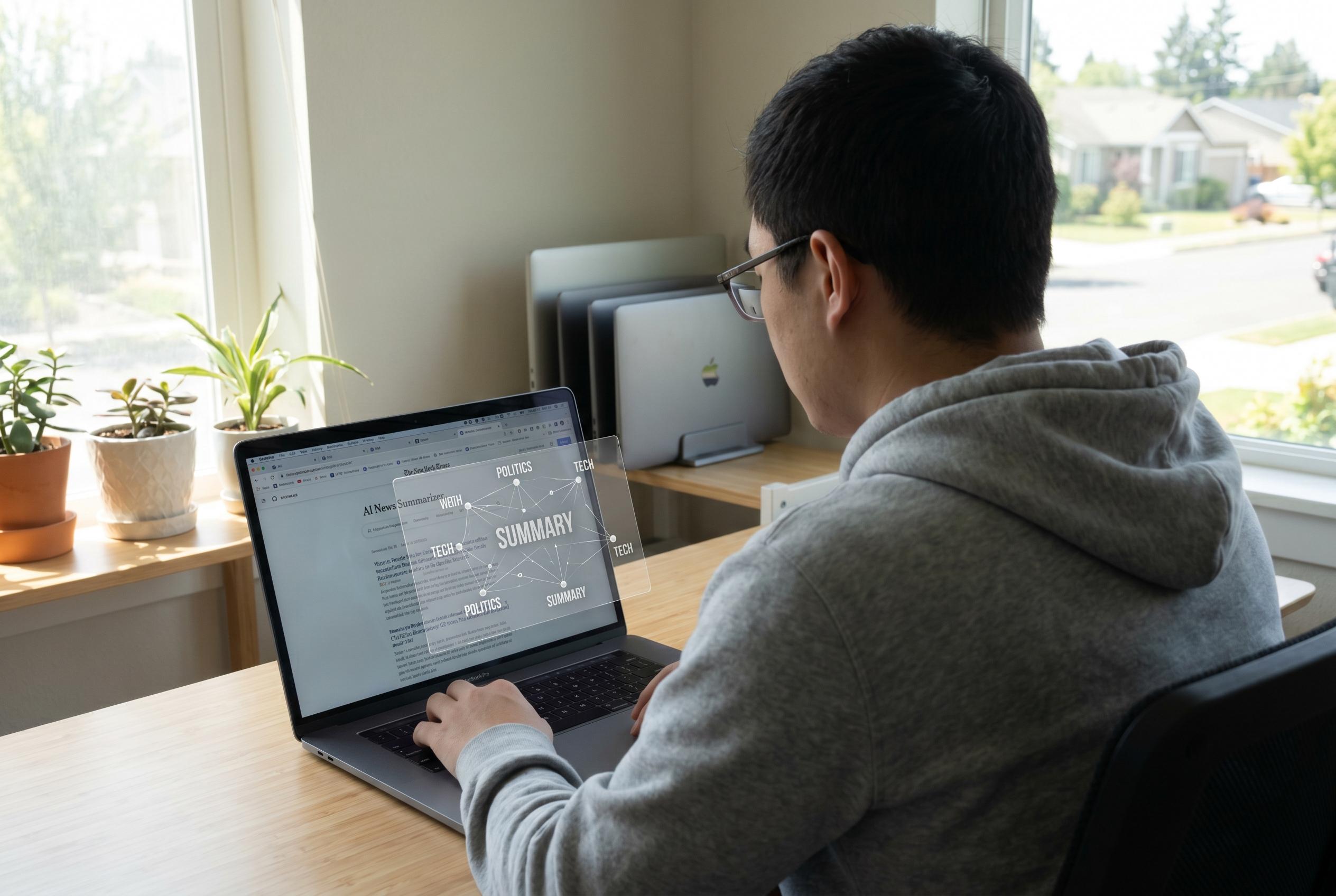
Shoppers and news addicts are trying a different fix: a local LLM, a handful of trusted RSS feeds and an automated script to produce a short, scheduled daily brief that trims the noise and restores control over what you actually read each morning.
Essential Takeaways
- Simple setup: A local LLM plus curated RSS feeds and a scheduled script can replace multiple noisy apps.
- Control over sources: You choose publications, skip algorithmic recommendations and avoid sensationalised timelines.
- Automation wins: Cron jobs or macOS automation keep the brief reliable without daily fiddling.
- Know the limits: Local models only summarise the inputs you give them and aren’t a substitute for breaking-news alerts.
- Iterative improvement: Misclassifications encourage prompt tuning and feed adjustments, improving the brief over time.
Why a local brief feels less noisy than another app
Start with a small sensory detail: the brief arrives as a quiet summary instead of a buzzing notification, and that difference matters. According to the original experience, the breakthrough wasn’t better AI but a workflow that began with sources the user deliberately chose. RSS feeds provide a clean, predictable stream compared with social timelines or recommendation tabs, so the LLM’s role becomes tidy and focused rather than adventurous.
That focus turns the morning scan into something calmer. You still get to open the full article when something matters, but the first pass is readable, short and, crucially, yours. If you’re fed up with multiple apps all competing for first-look real estate, a local brief reclaims that slot in your routine.
Which tools to start with and why Ollama is handy for automation
If you want this to run without babysitting, choose tooling that fits command-line workflows. Ollama is built for scripted, repeatable use, which makes it easier to plug into cron jobs or macOS automation and have the brief arrive consistently. By contrast, LM Studio is more forgiving when you’re in exploratory mode and want to tinker with prompts and models visually.
Practical tip: start in LM Studio to experiment with prompts and section labels, then switch to Ollama once you’re comfortable and want reliability. Keep the system on the same machine you actually use, macOS matters for lots of people, so the brief integrates with your existing habits.
How to pick feeds and avoid a noisy brief
The quality of the output depends on the quality of what you feed the model. Curate a handful of trusted publications, niche blogs and newsletters that actually reflect your interests, and drop aggregator apps that insert algorithmic choices. That boundary-setting is what transforms a summary from another noisy feed into a deliberately edited morning snapshot.
Practical advice: aim for variety but limit quantity, ten focused feeds often beat fifty indifferent ones. Label sections clearly in your prompt (e.g., “Tech policy, Quick reads, Weekend projects”) so the model sorts stories where you expect them and you spot misclassifications more easily.
Automation, housekeeping and making it stick
Automation is not glamorous, but it’s what turns a neat idea into a daily habit. A scheduled script that fetches feeds, runs the model and writes a brief to a file or sends it to an inbox means you don’t need to remember anything. Add simple housekeeping, delete the previous day’s articles, rotate logs, to avoid a cluttered local store and keep performance steady.
If you want to push notifications for genuinely urgent items, pair the brief with a separate alert channel. The brief is slow by design; it’s meant to be reflective, not a real-time wire.
Recognising limits and using them as strengths
A local LLM can mishandle context, flatten nuance or put a scorpion-with-metal story in the wrong section, as users have noted. That’s not a fatal flaw, it’s an invitation to refine prompts and feeds. Every odd result is feedback you can act on, which is the point of keeping the system local: you can change the machinery instead of complaining about a black-box recommendation engine.
Remember, these briefs aren’t a replacement for live newsrooms or breaking alerts. Think of them as a curated morning companion that reduces friction and helps you decide what deserves a deeper read.
Where this idea fits into a wider trend
IT leaders and industry commentators have noticed a move toward smaller, domain-specific models for tasks like this. Local models are proving useful in settings from editorial workflows to industrial automation because they offer privacy, lower latency and tighter control over inputs. Organisations and individuals who value predictability and control are increasingly choosing on-prem or local inference for those reasons.
If you’re weighing options, consider the trade-offs: local briefs are quieter and more private but require curation and maintenance. For many people, that’s a good trade.
It’s a small change that can make every morning feel less hectic and more deliberate.
Source Reference Map
Story idea inspired by: [1]
Sources by paragraph:
Noah Fact Check Pro
The draft above was created using the information available at the time the story first
emerged. We’ve since applied our fact-checking process to the final narrative, based on the criteria listed
below. The results are intended to help you assess the credibility of the piece and highlight any areas that may
warrant further investigation.
Freshness check
Score:
8
Notes:
The article was published on May 3, 2026, and appears to be original content. However, similar themes have been discussed in other recent articles, such as ‘I built a private voice assistant for my smart home using Home Assistant and a local LLM’ published on August 5, 2025 ([xda-developers.com](https://www.xda-developers.com/private-voice-assistant-for-smart-home-with-home-assistant-local-llm/?utm_source=openai)) and ‘I built a second brain using only Obsidian and a local LLM’ published on August 8, 2025 ([xda-developers.com](https://www.xda-developers.com/i-built-a-second-brain-using-only-obsidian-and-a-local-llm/?utm_source=openai)). These articles explore the use of local LLMs in personal applications, which may overlap with the current article’s content. ([xda-developers.com](https://www.xda-developers.com/private-voice-assistant-for-smart-home-with-home-assistant-local-llm/?utm_source=openai))
Quotes check
Score:
7
Notes:
The article includes direct quotes from the author, but no external sources are cited. Without external verification, the authenticity of these quotes cannot be confirmed. ([app.daily.dev](https://app.daily.dev/posts/building-a-local-llm-news-brief-taught-me-my-real-problem-wasn-t-the-sources-it-was-the-apps-eggpshxlp?utm_source=openai))
Source reliability
Score:
6
Notes:
The article is published on XDA Developers, a reputable technology news website. However, the author is not identified, which raises concerns about the credibility of the content. ([app.daily.dev](https://app.daily.dev/posts/building-a-local-llm-news-brief-taught-me-my-real-problem-wasn-t-the-sources-it-was-the-apps-eggpshxlp?utm_source=openai))
Plausibility check
Score:
8
Notes:
The article discusses the use of local LLMs to create personalized news briefs, a concept that aligns with current trends in AI and personal information management. Similar applications have been explored in other articles, such as the use of local LLMs for private voice assistants and personal knowledge management. ([xda-developers.com](https://www.xda-developers.com/private-voice-assistant-for-smart-home-with-home-assistant-local-llm/?utm_source=openai))
Overall assessment
Verdict (FAIL, OPEN, PASS): FAIL
Confidence (LOW, MEDIUM, HIGH): MEDIUM
Summary:
The article presents a personal account of building a local LLM news brief, but it lacks external verification and relies solely on the author’s experience. Similar themes have been discussed in other recent articles, which may indicate recycled content. The absence of an identified author further raises concerns about the credibility of the content. Given these issues, the article does not meet the necessary standards for publication.


