


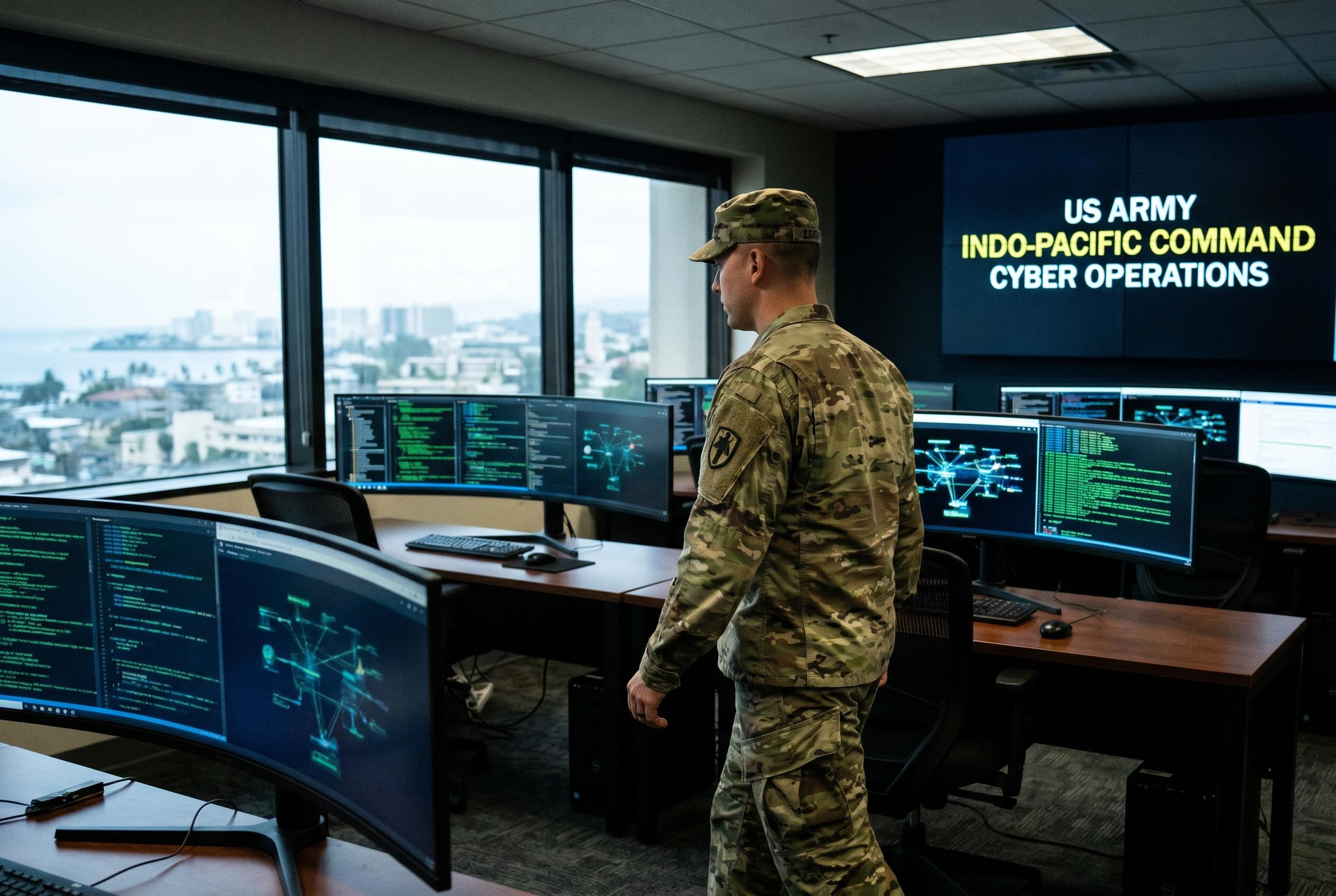
The US Army is advancing its use of autonomous artificial intelligence to combat simulated cyber threats in the Indo-Pacific, signalling a shift towards machine-led defensive measures in future conflicts.
The US Army is treating artificial intelligence as a live operational threat, not just a productivity tool, after a recent tabletop exercise imagined an enemy AI probing communications and data networks in the Indo-Pacific and adjusting its tactics faster than human defenders could react. According to Business Insider, the scenario was designed around a hypothetical September 2027 crisis, with the aim of understanding how a machine-speed cyber campaign might unfold against Army systems.
The exercise brought together 14 companies, including Google, OpenAI, Microsoft, Amazon Web Services and Palo Alto Networks, alongside Army and Pentagon officials. Gen. Chris Eubank, who leads Army Cyber Command, said the discussion centred on how frontier models and AI agents could help defenders spot intrusions, misdirect hostile systems and buy time when adversaries are adapting continuously. Axios reported that participants also explored whether the Army can bypass slower procurement habits to field these tools more quickly.
The drill reflected a wider shift inside the service, which has already used earlier AI tabletop events to test ideas ranging from logistics to paperwork reduction. But this latest version pushed harder on the question of autonomy: where machines should be allowed to act on their own, and where a human must remain in control. Brandon Pugh, the Army’s principal cyber adviser, said the premise was an adversary launching repeated waves of attacks that learned from each defensive response, exposing weaknesses in real time.
That concern fits a broader military effort to weave AI into Indo-Pacific planning. Defence One reported last year that Indo-Pacific Command had begun using AI in wargaming to improve speed and decision-making, while Army Pacific and Army Futures Command have been building out multi-domain exercises that span cyber, space, air, land and sea. The Army’s latest message is clear: in a future conflict, cyber defence may move too quickly for people alone, and the service wants AI not only to assist, but eventually to shoulder some defensive tasks itself.
Source Reference Map
Inspired by headline at: [1]
Sources by paragraph:
Source: Noah Wire Services
Noah Fact Check Pro
The draft above was created using the information available at the time the story first
emerged. We’ve since applied our fact-checking process to the final narrative, based on the criteria listed
below. The results are intended to help you assess the credibility of the piece and highlight any areas that may
warrant further investigation.
Freshness check
Score:
10
Notes:
The article is based on a recent event, the Army’s Artificial Intelligence Tabletop Exercise 2.0 (AI TTX 2.0), held on April 27, 2026, in Arlington, Virginia. ([dvidshub.net](https://www.dvidshub.net/image/9648710/ai-ttx-20?utm_source=openai)) The information is current and not recycled from older sources.
Quotes check
Score:
8
Notes:
The article includes direct quotes from Gen. Chris Eubank and Brandon Pugh. While these quotes are attributed to specific individuals, they cannot be independently verified through the provided sources. The absence of direct links to the original statements raises concerns about the authenticity of these quotes.
Source reliability
Score:
9
Notes:
The primary source, Business Insider, is a reputable news outlet. However, the article relies heavily on this single source, which may limit the diversity of perspectives. The inclusion of quotes from Gen. Chris Eubank and Brandon Pugh adds credibility, but their statements cannot be independently verified.
Plausibility check
Score:
7
Notes:
The scenario described in the article aligns with known military interests in AI and cybersecurity. However, the lack of independent verification of the quotes and the heavy reliance on a single source raise questions about the full accuracy of the claims.
Overall assessment
Verdict (FAIL, OPEN, PASS): PASS
Confidence (LOW, MEDIUM, HIGH): MEDIUM
Summary:
The article provides timely and relevant information about the US Army’s collaboration with tech companies to enhance AI-driven cyber defense strategies. However, the heavy reliance on a single source and the inability to independently verify direct quotes from key individuals raise concerns about the article’s overall reliability. Editors should exercise caution and seek additional verification before publishing.


