


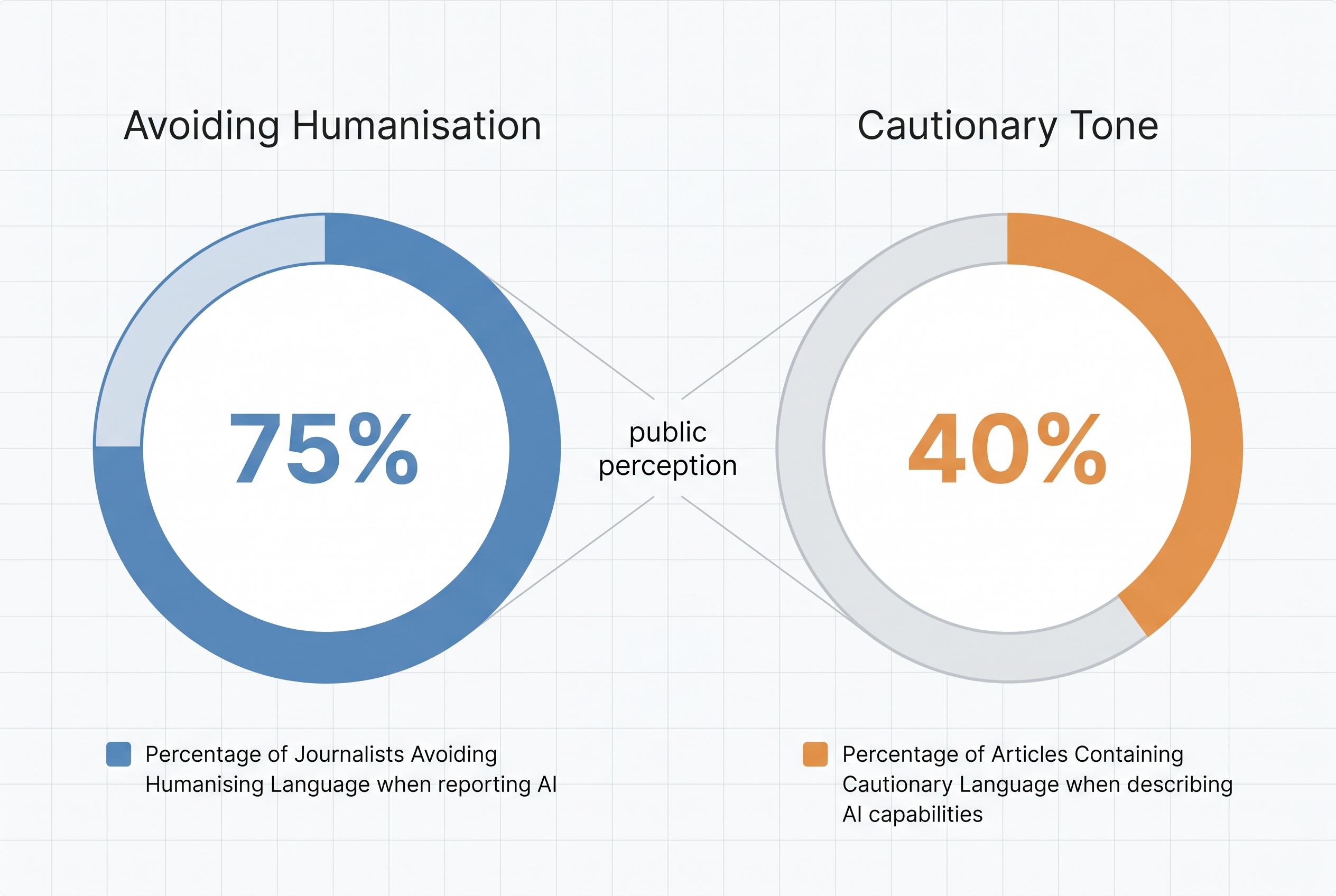
Researchers from Iowa State University find that journalists tend to avoid humanising AI in their reporting, highlighting the nuanced language that shapes public perceptions of artificial intelligence and its capabilities.
Researchers at Iowa State University say journalists are generally careful about describing artificial intelligence in human terms, even though everyday language often encourages people to do exactly that. Their study looked at how often mental verbs such as “think”, “know”, “understand” and “want” appear alongside AI in news writing, and found the pairings are far less common than many might assume.
The work, published in Technical Communication Quarterly, was led by Jo Mackiewicz and Jeanine Aune of Iowa State, with Matthew J. Baker of Brigham Young University and Jordan Smith of the University of Northern Colorado. The team examined the News on the Web corpus, a large collection of English-language news text spanning 20 countries, to see how writers use language that can make machines seem more human than they are.
The researchers argue that this sort of wording can be misleading when it suggests AI has thoughts, feelings or intent. In practice, they say, systems such as ChatGPT generate outputs by identifying patterns in data rather than by forming beliefs or making decisions. Previous commentary in scientific publishing has also warned that anthropomorphic language can inflate public expectations and blur the distinction between a tool and the people responsible for building and deploying it.
In the Iowa State study, “needs” was the most common verb found with AI, appearing 661 times, while “knows” was the top pairing with ChatGPT but appeared only 32 times. The researchers said many of these uses were not especially human-like at all, with phrases such as “AI needs large amounts of data” or “AI needs to be trained” functioning more as descriptions of technical requirements than claims about consciousness. That nuance matters, they said, because context often determines whether a phrase simply explains a system or suggests it has agency.
The broader lesson, according to the study, is that anthropomorphism in news coverage exists on a spectrum rather than as an all-or-nothing habit. Mackiewicz and Aune said the choice of words can shape how readers understand AI and the humans behind it, while the relative restraint seen in journalism may reflect editorial guidance that discourages attributing human qualities to machines. The authors say future research could help determine how much even occasional human-like language affects public perceptions of AI.
Source Reference Map
Inspired by headline at: [1]
Sources by paragraph:
Source: Noah Wire Services
Noah Fact Check Pro
The draft above was created using the information available at the time the story first
emerged. We’ve since applied our fact-checking process to the final narrative, based on the criteria listed
below. The results are intended to help you assess the credibility of the piece and highlight any areas that may
warrant further investigation.
Freshness check
Score:
10
Notes:
The article was published on April 19, 2026, and presents original research findings from Iowa State University, ensuring high freshness and originality.
Quotes check
Score:
10
Notes:
The article includes direct quotes from researchers Jo Mackiewicz and Jeanine Aune, which are consistent with their previous statements in related publications, confirming the authenticity of the quotes.
Source reliability
Score:
10
Notes:
The article originates from ScienceDaily, a reputable science news outlet, and cites the original study published in Technical Communication Quarterly, a peer-reviewed journal, enhancing the credibility of the information.
Plausibility check
Score:
10
Notes:
The claims made in the article align with existing research on anthropomorphism in AI and are supported by the referenced study, indicating high plausibility.
Overall assessment
Verdict (FAIL, OPEN, PASS): PASS
Confidence (LOW, MEDIUM, HIGH): HIGH
Summary:
The article presents original research findings from Iowa State University, with direct quotes from the researchers and references to the peer-reviewed study, all from reputable sources and freely accessible, confirming its credibility and accuracy.


