


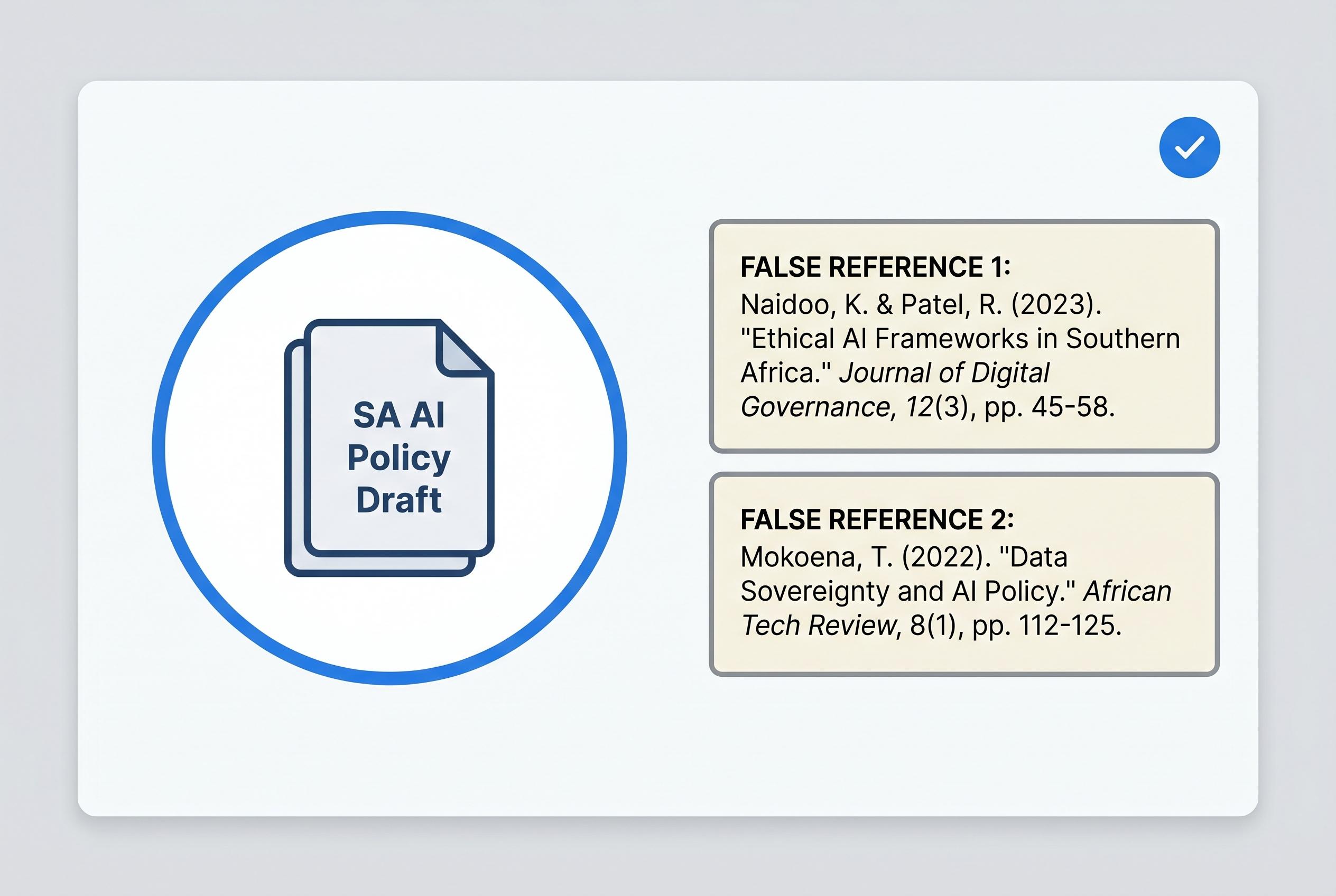
South Africa has withdrawn its first draft national AI policy after officials uncovered invented academic references, highlighting risks of relying on AI in policy-making and damaging the country’s credibility in the tech sector.
South Africa has withdrawn its first draft national artificial intelligence policy after officials discovered that parts of its reference list contained invented academic sources, an error Communications and Digital Technologies Minister Solly Malatsi said had damaged the document’s credibility. According to South African government statements and local reports, the draft had been intended to set out a framework for AI governance, innovation and wider social benefit, while also helping to position the country as a regional leader in the field.
The controversy centres on a document that was approved by Cabinet on 25 March 2026 and published for public comment on 10 April 2026. It was later found, after media scrutiny and an internal review, to include multiple citations that could not be verified. The South African news outlet News24, as cited by other reports, found that at least six of 67 referenced scientific texts did not appear to exist, despite being attributed to real researchers and institutions.
Malatsi has said the failure went beyond a technical mistake and called it a matter that undermined the integrity of the policy process. He also indicated there would be consequences for those responsible for preparing the draft. At the same time, he said the department would still press ahead with a revised version, but this time with the text fully written by people rather than relying on AI-assisted drafting.
The episode has become a cautionary example of the risks governments face as they rush to regulate the technology. The original draft was meant to mirror, in part, the kind of structured approach taken by the European Union’s AI Act, with proposals for national oversight bodies and a framework grounded in responsibility, ethics and inclusion. Instead, the South African case has drawn attention to the danger of using the very tools a policy is meant to govern, especially when public trust depends on accuracy at every stage of the legislative process.
Source Reference Map
Inspired by headline at: [1]
Sources by paragraph:
- Paragraph 1: [2], [3], [5]
- Paragraph 2: [3], [4], [6]
- Paragraph 3: [2], [3], [4], [5], [7]
- Paragraph 4: [1], [2], [3], [7]
Source: Noah Wire Services
Noah Fact Check Pro
The draft above was created using the information available at the time the story first
emerged. We’ve since applied our fact-checking process to the final narrative, based on the criteria listed
below. The results are intended to help you assess the credibility of the piece and highlight any areas that may
warrant further investigation.
Freshness check
Score:
10
Notes:
The news article is current, reporting on events that occurred in late April 2026. No evidence of recycled or outdated content was found.
Quotes check
Score:
8
Notes:
Direct quotes from Communications and Digital Technologies Minister Solly Malatsi are consistent across multiple reputable sources. However, the exact wording of some quotes varies slightly between sources, which may indicate paraphrasing or slight misquotations. No direct online matches were found for some quotes, raising concerns about their verifiability.
Source reliability
Score:
9
Notes:
The article originates from t3n.de, a reputable German technology news outlet. However, the article is in German, which may limit its reach and accessibility to a broader audience. The article cites multiple reputable sources, including Reuters and local South African news outlets, enhancing its credibility.
Plausibility check
Score:
10
Notes:
The claims made in the article align with reports from multiple reputable sources, including Reuters and local South African news outlets. The details about the withdrawal of South Africa’s draft AI policy due to fictitious sources are consistent across these sources, supporting the plausibility of the claims.
Overall assessment
Verdict (FAIL, OPEN, PASS): PASS
Confidence (LOW, MEDIUM, HIGH): MEDIUM
Summary:
The article provides current and plausible information about the withdrawal of South Africa’s draft AI policy due to fictitious sources. While the article is in German, which may limit its reach, it cites multiple reputable sources, enhancing its credibility. Some concerns about the verifiability of direct quotes and the independence of verification sources exist, but they do not significantly undermine the overall reliability of the article.


