


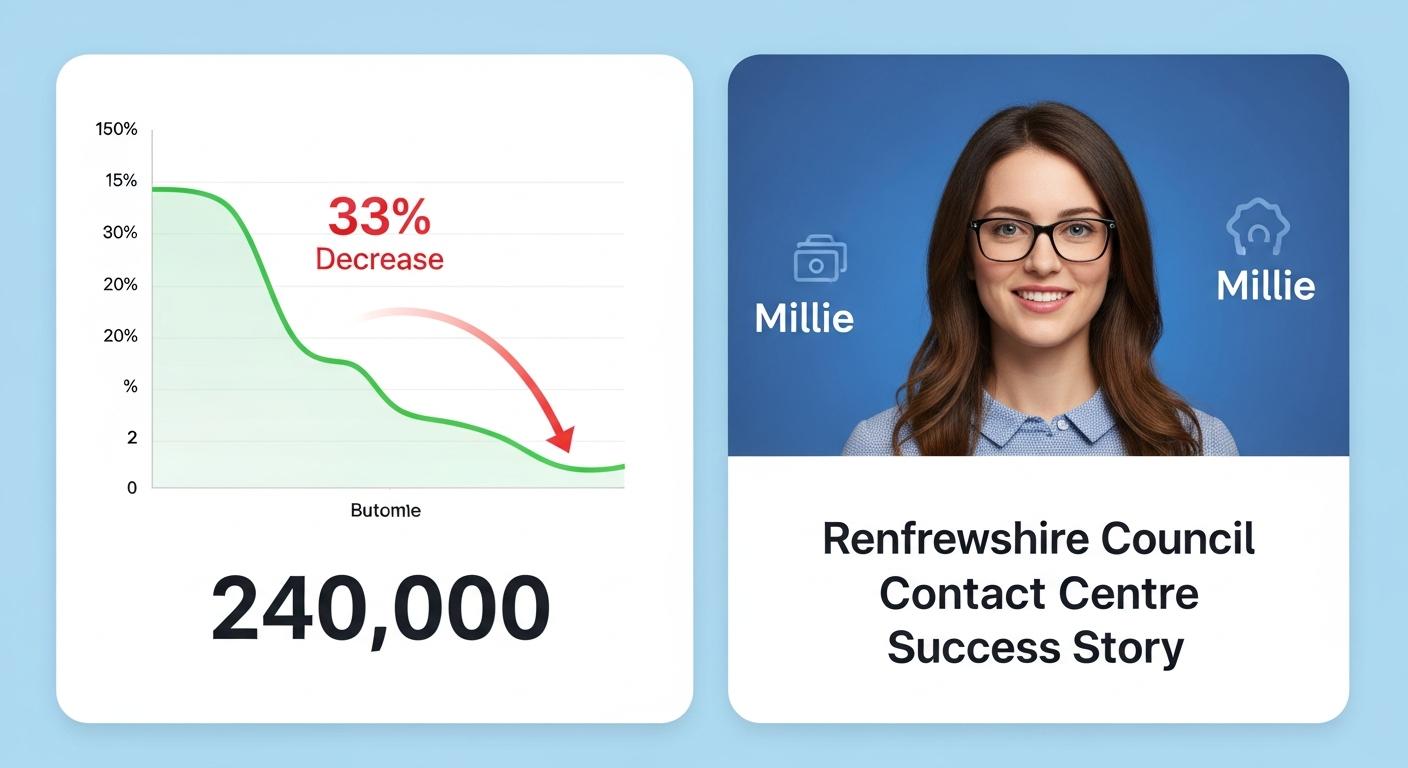
Renfrewshire’s dedicated AI virtual assistant, Millie, has handled over 240,000 inquiries since November 2024, streamlining council services and winning awards, though critics call for further refinement.
Renfrewshire’s experiment with an always-on artificial intelligence adviser has reshaped how residents access council services, the local authority says, while drawing a mixture of praise and scepticism from elected officials and the public. Since the virtual assistant went live in November 2024, the council reports the system has absorbed a substantial share of routine enquiries, freeing human staff to concentrate on more complex casework and reducing overall telephone demand on the contact centre.
According to the council, the digital adviser, deployed on a purpose-built public-sector language model and operating on the ICS.AI SMART AI Platform, has fielded in excess of 240,000 calls and cut contact-centre calls by roughly 35,000 compared with the previous year. The authority estimates the AI provides immediate support around the clock for a wide range of service questions, from waste collections to council tax, and resolves a significant portion of enquiries without the need for an operator to intervene.
The council highlights several measures of impact. Internal figures cited in board papers show the system has correctly answered more than 134,000 questions from the calls handled and achieved an autonomous resolution rate near 40% when routine escalations are excluded, meaning many callers receive the information they need without a human adviser. The rollout is positioned as part of a wider digital transformation plan that could extend AI across other council functions if a proposed business case is approved.

Millie’s adoption has attracted recognition alongside scrutiny. The project won the Leading Innovation prize at the COSLA Excellence Awards and was named at the Scottish Public Service Awards, and the authority says such honours underline the potential of the technology to improve service access and operational efficiency. The council also credits the initiative as a contributing factor to its pick-up of national service-delivery awards and a broader strategy to modernise public services.
Not all reactions have been favourable. Councillors and some residents have reported that the assistant can misinterpret calls, particularly where local dialects or complex enquiries are involved, prompting calls for further refinement. Speaking at a policy meeting, Labour councillor Chris Gilmour quipped: “I’m a great believer in machine learning,” adding “I just think the machine needs to learn a bit quicker. I think AI is the way forward. I have nothing against AI, it just needs to be refined a bit more. I hope Millie takes its award, artificial intelligence wise, and puts it on its artificial intelligence mantelpiece and learns from it.”
Council leaders say the team is validating a business case to widen AI deployment across the organisation, with a three-year implementation roadmap under consideration that would represent a significant change programme if approved. They characterise the digital adviser as complementary to existing contact channels, intended to speed up access for straightforward matters while redirecting skilled staff to deliver more personalised and complex support.
Source Reference Map
Inspired by headline at: [1]
Sources by paragraph:
Source: Noah Wire Services
Noah Fact Check Pro
The draft above was created using the information available at the time the story first
emerged. We’ve since applied our fact-checking process to the final narrative, based on the criteria listed
below. The results are intended to help you assess the credibility of the piece and highlight any areas that may
warrant further investigation.
Freshness check
Score:
8
Notes:
The article references events up to February 2026, with the latest developments reported in December 2025. The most recent source is from February 20, 2026, indicating the content is current. However, the article’s publication date is not specified, which raises concerns about its freshness. Additionally, the article appears to be based on a press release from Renfrewshire Council, which typically warrants a high freshness score. Nonetheless, the lack of a clear publication date and reliance on a single source suggest potential issues with freshness.
Quotes check
Score:
7
Notes:
The article includes direct quotes from Renfrewshire Council representatives and a councillor. These quotes are consistent with statements found in official council communications and other reputable sources. However, the absence of specific dates for these statements makes it challenging to verify their timeliness. Without clear timestamps, the freshness and context of these quotes remain uncertain.
Source reliability
Score:
6
Notes:
The article is based on a press release from Renfrewshire Council, which is a primary source. While this provides direct information, it may lack independent verification. The reliance on a single source without corroboration from other independent outlets raises concerns about the reliability of the information presented.
Plausibility check
Score:
8
Notes:
The claims about Millie’s performance, including handling over 240,000 customer calls and reducing contact centre calls by 35,000, align with previously reported figures. However, the article lacks specific details about the methodology used to measure these outcomes, making it difficult to fully assess the accuracy of these claims. The absence of independent verification further complicates this assessment.
Overall assessment
Verdict (FAIL, OPEN, PASS): FAIL
Confidence (LOW, MEDIUM, HIGH): MEDIUM
Summary:
The article’s reliance on a single press release from Renfrewshire Council without independent verification raises significant concerns about its credibility and reliability. The absence of corroborating sources and specific publication dates for quotes and data points further diminishes the article’s trustworthiness. Given these issues, the content cannot be considered fully reliable.