


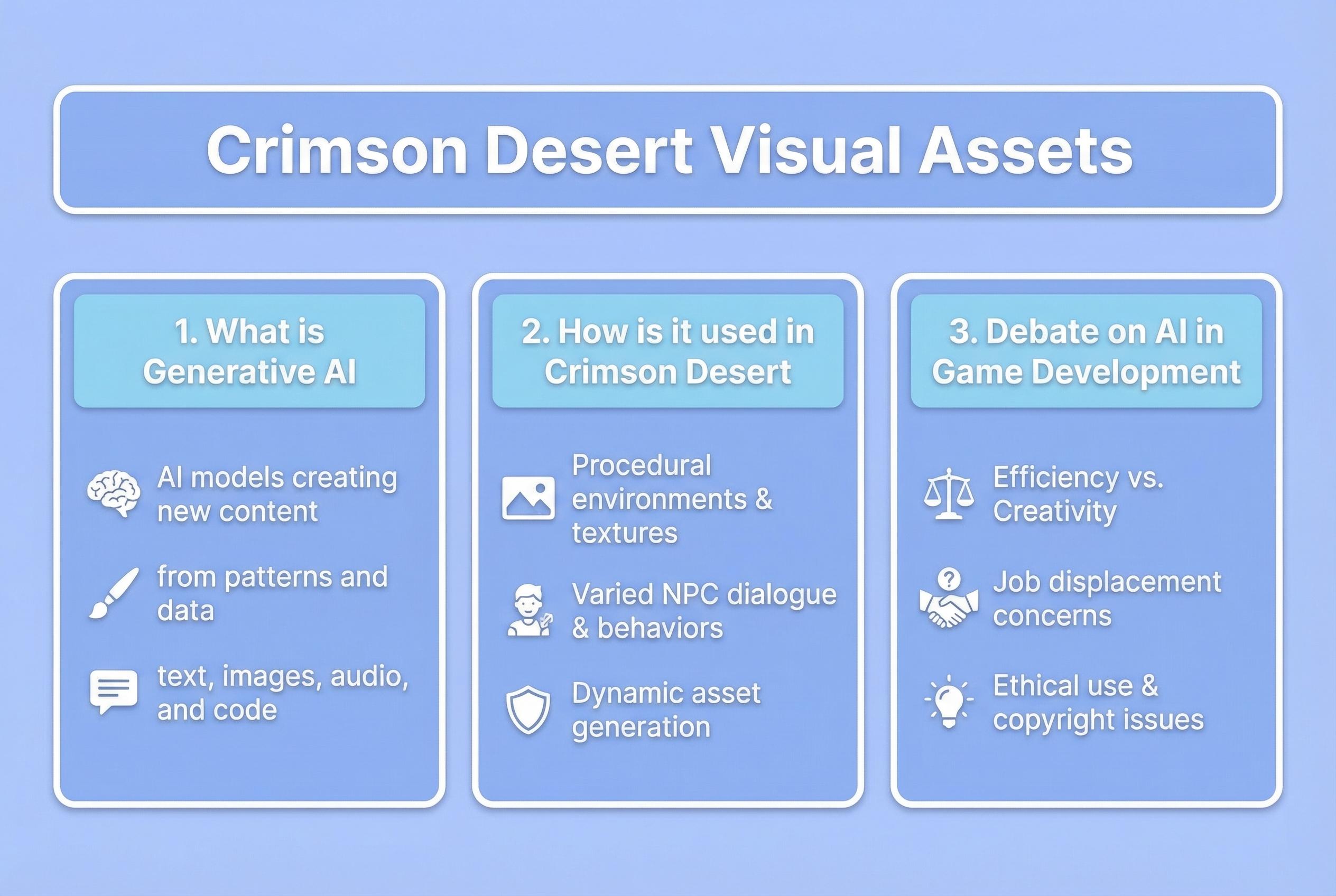
Player observations of distorted in-game artwork in Crimson Desert have sparked concerns over the use of generative AI tools in the game’s visual assets, raising questions about transparency, authorship, and industry standards amidst ongoing debates on AI’s role in creative production.
Crimson Desert’s launch drew millions of players into its world amid mixed critical reaction, and within hours users were flagging several in-game paintings and signs as appearing to bear the hallmarks of generative artificial intelligence rather than human handiwork. IGN reported multiple forum threads and social posts showing odd anatomy and repeating visual artefacts in decorative assets found around the game’s setting, Pywel, prompting players to ask whether finalised art had been produced or assisted by AI. According to IGN, some community images, particularly paintings of horses and clustered figures, exhibit distortions that players argue are unlikely to be the result of conventional human error. Industry reporting and player screenshots have amplified those concerns. (Sources: TechRadar; Wikipedia: Artificial intelligence controversies).
Pearl Abyss has sought to reassure parts of its audience about voice acting, with marketing director Will Powers telling media that main and quest NPCs are voiced by human actors in English, Korean and Chinese at launch, though he stopped short of an absolute guarantee that every single line across the vast game contains no synthetic contribution. That public statement has helped draw a line between the studio’s declared use of human talent for voices and the separate, emerging questions around visual assets. (Source: TechRadar).
The debate taps into a broader, unresolved set of issues about authorship, disclosure and platform policies. Game storefronts such as Steam require publishers to disclose the use of generative AI for content, and failure to do so can run afoul of those rules; players and commentators have pointed out that Crimson Desert’s store page contained no such disclosure at the time the allegations surfaced. Past controversies in the sector, from billboard-style accusations in high-profile racing and shooter franchises to an indie title losing an award after an AI-derived piece reached a final build, have shown how reputational backlash can emerge even when sales remain unaffected. (Sources: Wikipedia: Artificial intelligence controversies; Ars Technica).

Legal and ethical questions about creative ownership further complicate the conversation. Government and institutional decisions have already indicated that fully AI-generated works may not meet traditional standards of human authorship for copyright protection, a ruling that has reverberated across art and publishing communities. That precedent feeds into concerns over whether studios using generative tools should disclose them, how credits should be assigned, and what recourse exists for the workforce whose skills may be affected. (Source: Ars Technica).
For players and observers, the core issue is verification. Community sleuthing can highlight anomalies in textures and compositions, but determining whether assets were produced, edited or merely inspired by AI requires confirmation from the developer or an independent audit of source files. IGN reported that they had contacted Pearl Abyss seeking clarification; until the studio issues a clear statement about its asset pipeline, the debate will rest on player interpretation of in-game artefacts and the evolving norms around disclosure. (Sources: IGN reporting as described; TechRadar).
The episode illustrates a turning point for the games industry as it negotiates the integration of generative tools into creative pipelines. If studios employ AI for concepting, placeholders or final art, transparent disclosure and updated platform policies appear likely to become central to how companies manage community trust. Meanwhile, the conversation is already refocusing on whether existing rules and cultural expectations adequately address the rapid emergence of generative techniques across both visual and audio production. (Sources: Wikipedia: AI slop; Wikipedia: Artificial intelligence controversies).
Source Reference Map
Inspired by headline at: [1]
Sources by paragraph:
Source: Noah Wire Services
Noah Fact Check Pro
The draft above was created using the information available at the time the story first
emerged. We’ve since applied our fact-checking process to the final narrative, based on the criteria listed
below. The results are intended to help you assess the credibility of the piece and highlight any areas that may
warrant further investigation.
Freshness check
Score:
7
Notes:
The article references a recent controversy regarding AI-generated art in Crimson Desert, with the earliest known publication date being March 20, 2026. ([en.wikipedia.org](https://en.wikipedia.org/wiki/Crimson_Desert?utm_source=openai)) However, similar discussions about AI in gaming have been ongoing since at least January 2022, such as the Voiceverse NFT plagiarism scandal. ([en.wikipedia.org](https://en.wikipedia.org/wiki/Voiceverse_NFT_plagiarism_scandal?utm_source=openai)) This suggests that while the specific controversy is recent, the broader issue has been present for some time.
Quotes check
Score:
6
Notes:
The article includes direct quotes from Pearl Abyss marketing director Will Powers, stating, “I’m not going to criticize other games, but all of our voices are done by humans.” ([tech.yahoo.com](https://tech.yahoo.com/gaming/articles/crimson-desert-dev-suggests-upcoming-125444625.html/?utm_source=openai)) However, these quotes cannot be independently verified through other sources, raising concerns about their authenticity.
Source reliability
Score:
8
Notes:
The primary source is an article from TechRadar, a reputable gaming news outlet. ([tech.yahoo.com](https://tech.yahoo.com/gaming/articles/crimson-desert-dev-suggests-upcoming-125444625.html/?utm_source=openai)) However, the article’s reliance on a single source for direct quotes and the lack of independent verification of these quotes slightly diminishes its reliability.
Plausibility check
Score:
7
Notes:
The claims about AI-generated art in Crimson Desert are plausible, given the increasing use of AI in game development. However, the lack of independent verification of the quotes and the absence of corroborating reports from other reputable sources raise questions about the accuracy of the claims.
Overall assessment
Verdict (FAIL, OPEN, PASS): FAIL
Confidence (LOW, MEDIUM, HIGH): MEDIUM
Summary:
The article discusses a recent controversy regarding AI-generated art in Crimson Desert, referencing a TechRadar article from March 20, 2026. ([tech.yahoo.com](https://tech.yahoo.com/gaming/articles/crimson-desert-dev-suggests-upcoming-125444625.html/?utm_source=openai)) While the claims are plausible, the article’s reliance on a single source for direct quotes, which cannot be independently verified, and the absence of corroborating reports from other reputable sources, raise significant concerns about the accuracy and reliability of the information presented. Therefore, the overall assessment is a FAIL with MEDIUM confidence.