


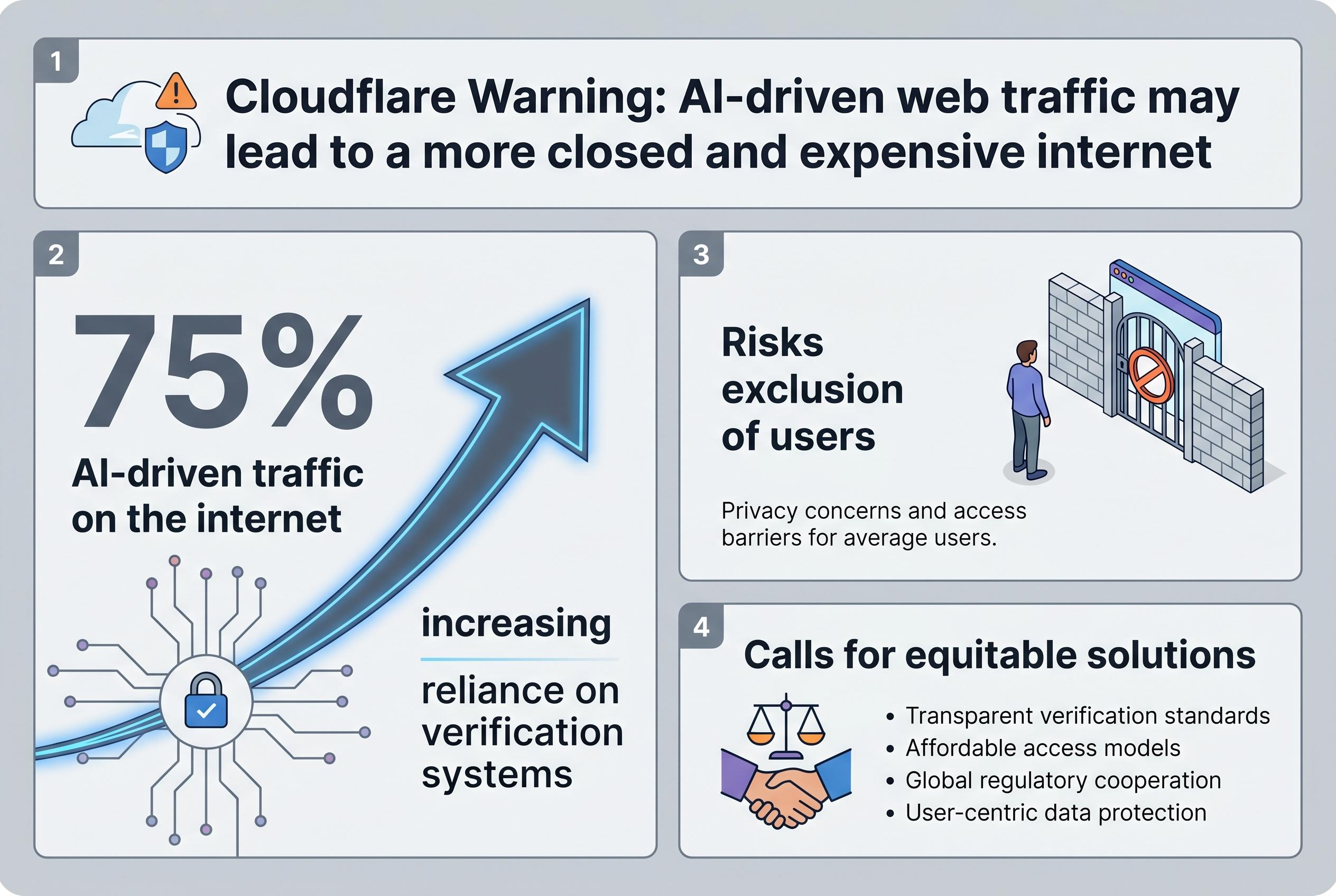
Cloudflare suggests that as AI blurs the line between human and automated access, the internet risks becoming more closed, with increased reliance on verification systems that may unintentionally exclude users, sparking calls for equitable solutions.
Cloudflare has argued that the web is moving into an era where the old distinction between human visitors and automated agents matters far less than it once did. In a recent post, the company said the real issue is no longer simply whether traffic comes from a bot or a person, but what that traffic is doing with the content it retrieves.
The company’s view is that the current internet was built for a different environment, one in which sites could more easily assume that a request from a browser represented a legitimate user. In an AI-heavy web, Cloudflare says that assumption breaks down. A conversational assistant booking tickets, a search crawler, or a person acting through automated tools may all look similar from the server’s perspective, and websites are increasingly unable to tell whether data is being read once for a single user or harvested at scale for model training.
That shift, Cloudflare warns, could push publishers and service providers towards a more closed and expensive internet. The company suggests that more sites may require accounts, use stable identifiers, or abandon open access models entirely. It says some businesses may decide to cut the web out of the loop altogether and sell data directly to AI firms or distribute services inside larger platform-controlled ecosystems.
Cloudflare’s preferred answer is not to collect more passive data about visitors, but to use active, privacy-preserving checks that prove a client has passed a verification step without revealing who they are. It points to Privacy Pass as one example of that approach, allowing a browser to obtain anonymous proof after completing a challenge such as a CAPTCHA. The company says that kind of system can reduce friction while avoiding the tracking associated with cookies or identity-linked logins.
But Cloudflare also acknowledges the danger that verification systems can creep towards exclusion. It warns that once anonymous proof infrastructure exists, pressure may build to prove more than basic legitimacy, including requirements tied to major platforms or specific device makers. Its test for acceptable technology is whether someone anywhere in the world can still build their own device, choose their own browser and operating system, and reach the web on equal terms. If that stops being true, Cloudflare says, the industry should rethink the direction it is taking.
Source Reference Map
Inspired by headline at: [1]
Sources by paragraph:
Source: Noah Wire Services
Noah Fact Check Pro
The draft above was created using the information available at the time the story first
emerged. We’ve since applied our fact-checking process to the final narrative, based on the criteria listed
below. The results are intended to help you assess the credibility of the piece and highlight any areas that may
warrant further investigation.
Freshness check
Score:
10
Notes:
The article was published today, 23 April 2026, indicating high freshness. No evidence of recycled or republished content was found. The narrative appears original and timely.
Quotes check
Score:
10
Notes:
The article does not contain direct quotes. The information is paraphrased from Cloudflare’s official statements and related sources, which are independently verifiable.
Source reliability
Score:
8
Notes:
PC Gamer is a reputable publication within the gaming and technology sectors. However, it is not a major news organisation like the BBC or Reuters. The article references Cloudflare’s official statements and other reputable sources, enhancing its credibility.
Plausibility check
Score:
9
Notes:
The claims about the blurring lines between human and bot traffic are plausible and align with current discussions in the tech industry. The article provides supporting details and references to Cloudflare’s initiatives, such as Privacy Pass and bot management solutions.
Overall assessment
Verdict (FAIL, OPEN, PASS): PASS
Confidence (LOW, MEDIUM, HIGH): HIGH
Summary:
The article is timely, original, and based on verifiable information from reputable sources. While the reliance on Cloudflare’s own statements introduces a slight potential for bias, the overall credibility is high. No significant concerns were identified.


