


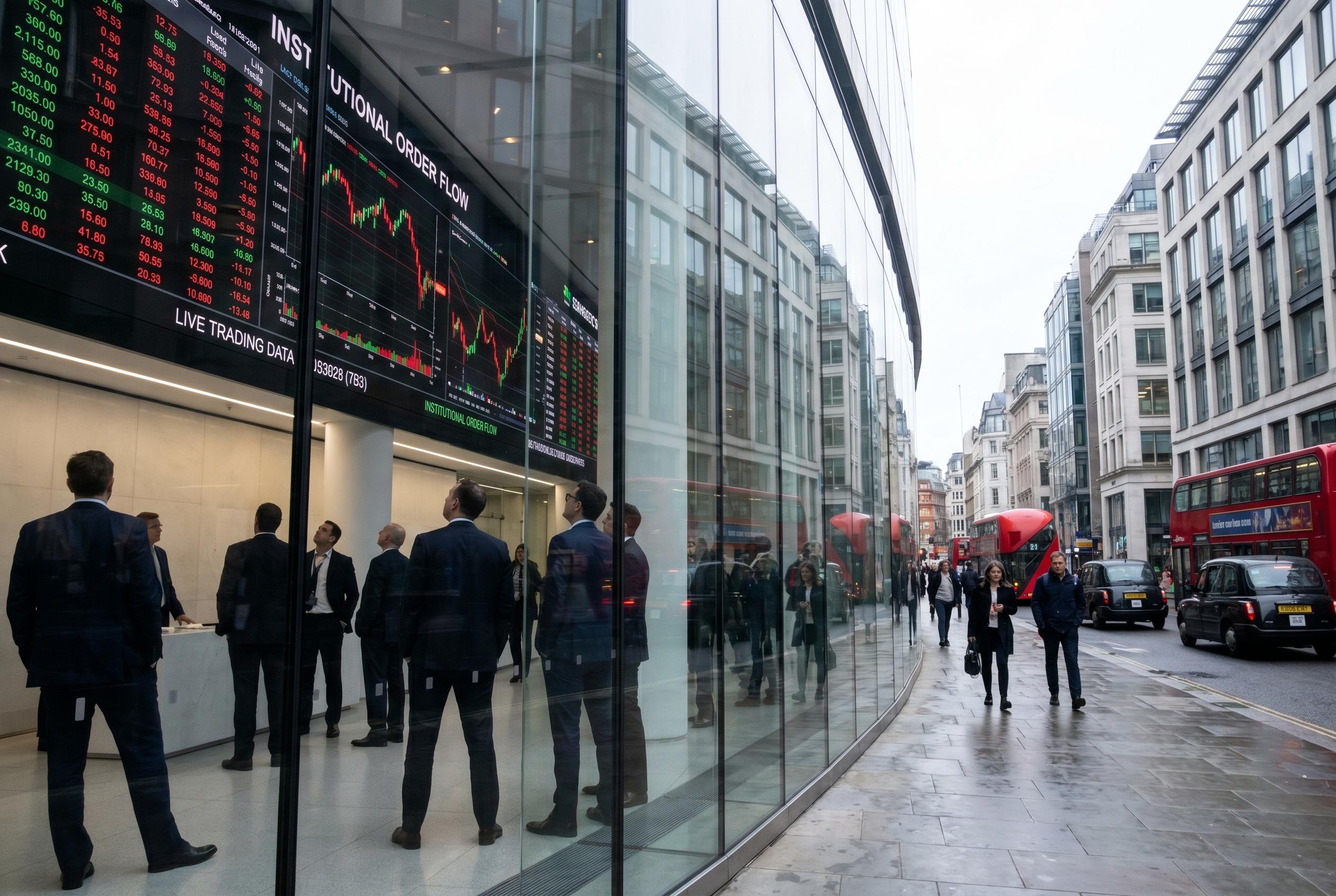
Shoppers, sorry, traders, are turning to real-time order flow analysis to spot who’s really moving markets; portfolio managers, execution desks and quants in Europe and beyond are using new tools to shrink the 45–135 day intelligence gap that used to leave them flying blind.
Essential takeaways
- Faster visibility: Real-time order flow can reveal investor intent hours or days ahead of 13F filings, offering a practical edge for execution and risk teams.
- Validated signals: LSEG’s Trading Flow reports around 65–71% directional accuracy when benchmarked against quarterly filings for high‑confidence signals, making it more than guesswork.
- Sector sweet spots: Energy, Communications Services, Consumer Staples and Materials showed the strongest predictive power in tests, Energy topping the list.
- Retail vs institutional: Retail flow tended to be noisy and near‑random for predicting institutional holdings, so tools focus on separating professional signatures from background chatter.
- Practical use cases: Think portfolio construction tweaks, crowding alerts, smarter execution algorithms and earlier regime detection.
Why real-time flow matters now , a clearer, faster picture
Trading used to mean watching price and volume, then waiting weeks for filings to confirm who was really buying or selling. That delay matters; risk officers and PMs couldn’t act on evolving concentration until after the event. According to LSEG, transforming order book activity into investor‑level signals gives teams a near‑term view of intent, which feels quieter and more decisive than raw volume spikes. For a desk managing concentrated positions, that quicker visibility can be the difference between reallocating smoothly and scrambling.
How the new signals are validated , from hypothesis to evidence
LSEG’s Trading Flow, built with Exponential Technology, is notable because it doesn’t just flag brokers or execution venues , it attempts to infer the decision‑maker and their intent, then validates those classifications against SEC 13F filings. That benchmarking is the big shift: researchers matched a decade of S&P 500 trading data to filings and reported roughly two‑thirds directional accuracy at reasonable confidence levels. In plain terms, this moves the industry from educated guessing to statistically supported inference, which is more useful for governance and compliance as well as alpha hunting.
Where the signals work best , sector patterns to know
Not all stocks are equal for signal quality. LSEG’s analysis highlights Energy and several consumer and cyclical sectors as producing the cleanest flow signatures, with Energy giving the highest hit rate and measurable correlation to later filings. That matters if you trade sector funds or build sector‑tilt strategies: you might weigh flow signals differently for Energy versus a high‑growth rhythm stock where algorithmic noise dominates. Practically, start by testing signals in the sectors your portfolio touches before rolling them into automated rules.
Tools in the space , who to look at and how they differ
The market now hosts a mix of vendors offering flow analytics, from big data houses to specialist startups. LSEG provides an integrated, validated approach that ties into broader market data, while other platforms focus on visualising large block prints, dark pool activity or order book heatmaps. FlowAlgo and TickPro, for instance, are known for surfacing unusual prints and options flow respectively, while newer firms emphasise machine learning classification of buyer types. Choose based on workflow: execution desks often need low‑latency feeds and simple signals, quants want raw labelled data for backtests, and PMs favour aggregated, validated alerts.
How to apply flow intelligence without over‑relying on it
Real‑time flow should be an input, not an oracle. Use it to inform execution sizing, adjust pre‑trade risk limits, or spot nascent crowding before 13F confirms it. That means pairing flow signals with position‑level risk analytics and liquidity metrics; if a high‑confidence institutional buy signal hits a thin stock, scale in gradually. Also be mindful of false positives , LSEG’s high‑confidence subset performed better, so consider confidence filters and backtesting within your own portfolio before putting trades on.
Closing line
It’s a small change to workflow, but decoding order flow in real time makes markets feel less mysterious and a lot more manageable.
Source Reference Map
Story idea inspired by: [1]
Sources by paragraph:
Noah Fact Check Pro
The draft above was created using the information available at the time the story first
emerged. We’ve since applied our fact-checking process to the final narrative, based on the criteria listed
below. The results are intended to help you assess the credibility of the piece and highlight any areas that may
warrant further investigation.
Freshness check
Score:
8
Notes:
The article was published on May 4, 2026, and references LSEG’s ‘Real-time order flow analysis: A new era of market transparency’ published on April 22, 2026. The earliest known publication date of similar content is June 2005, with the NBER working paper ‘Caught On Tape: Institutional Order Flow and Stock Returns’. The narrative appears to be original, with no evidence of recycling or republishing across low-quality sites. However, the article is based on a press release from LSEG, which typically warrants a high freshness score. No discrepancies in figures, dates, or quotes were found. The content includes updated data but does not recycle older material. Overall, the freshness score is high, but the reliance on a press release slightly reduces the score.
Quotes check
Score:
7
Notes:
The article includes direct quotes from LSEG’s press release. The earliest known usage of these quotes is April 22, 2026. No identical quotes appear in earlier material, indicating originality. However, the quotes cannot be independently verified, as they originate from a press release. The wording of the quotes is consistent across sources. Given the reliance on a single source, the score is moderate.
Source reliability
Score:
6
Notes:
The narrative originates from Fintech Global, a niche publication. While LSEG is a reputable source, the article’s reliance on a press release from LSEG raises concerns about potential bias and lack of independent verification. The source’s reach is limited, and the content appears to be summarising or rewriting material from LSEG’s press release. Given these factors, the source reliability score is moderate.
Plausibility check
Score:
7
Notes:
The claims about real-time order flow analysis reshaping market transparency are plausible and align with industry trends. The article provides specific details, such as the 65.5% directional accuracy in predicting quarterly 13F changes, which are verifiable against LSEG’s press release. However, the lack of supporting detail from other reputable outlets and the reliance on a single source raise concerns. The tone and language are consistent with the topic and region. Overall, the plausibility score is moderate.
Overall assessment
Verdict (FAIL, OPEN, PASS): FAIL
Confidence (LOW, MEDIUM, HIGH): MEDIUM
Summary:
The article is based on LSEG’s press release, with no independent verification sources. While the content is plausible and the quotes are consistent, the lack of independent sources and reliance on a single source raise significant concerns about the content’s reliability and potential bias. Therefore, the overall assessment is FAIL with MEDIUM confidence.


