


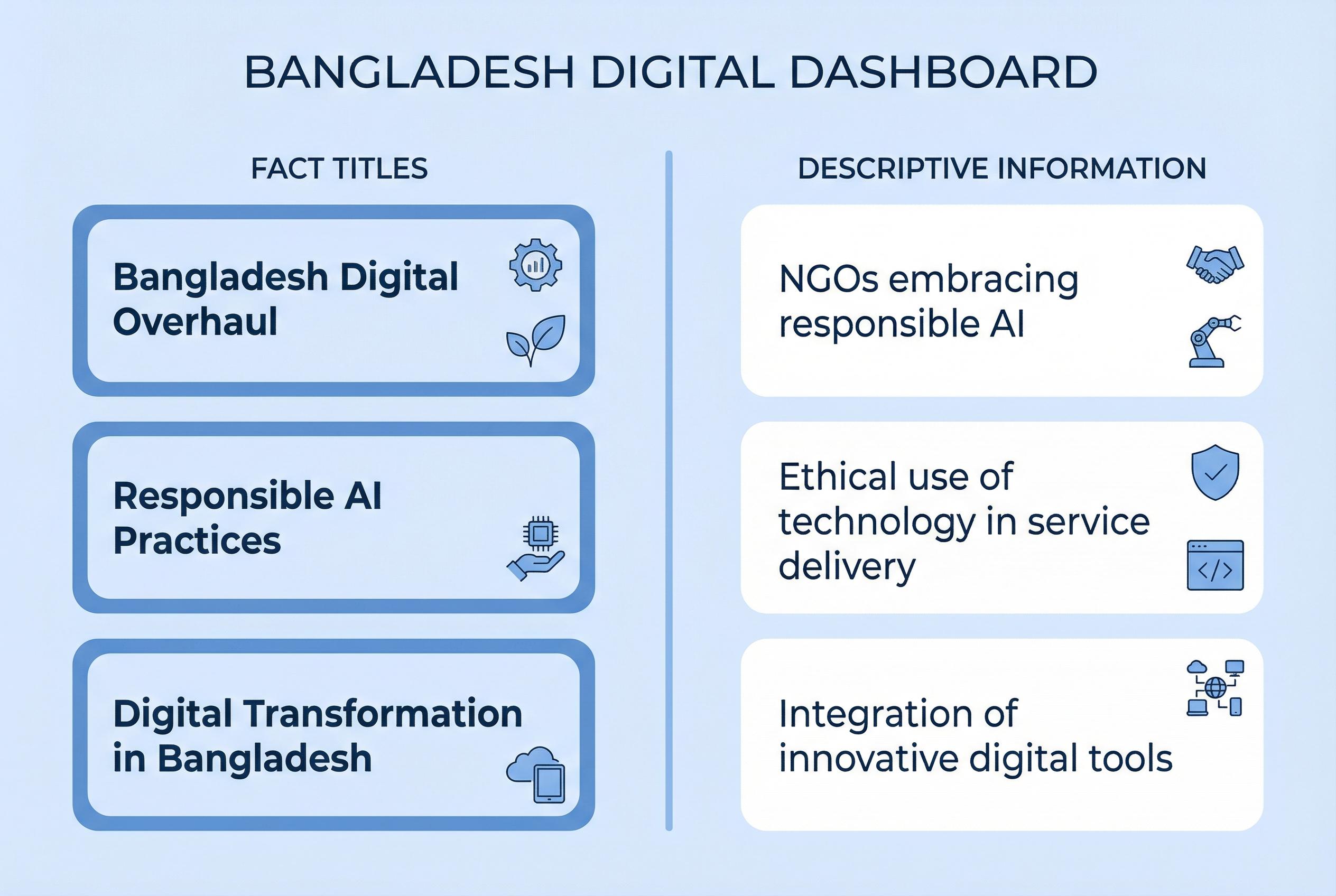
An orientation workshop in Dhaka introduces innovative digital tools and responsible AI practices to modernise NGO operations across Bangladesh, highlighting a shift towards ethical and integrated technological solutions.
An orientation workshop in Dhaka unveiled a programme of digital reforms and responsible artificial intelligence aimed at modernising how non-governmental organisations operate across Bangladesh. According to a press release by BSS, the NGO Affairs Bureau, backed by the United Nations Development Programme and supported by the Australian Government’s ISPAT project, staged sessions to introduce an NGOAB Online Solution alongside guidance on using AI to boost service delivery and oversight.
Senior officials framed the shift as both an opportunity and a duty. Barrister Md. Khalilur Rahman Khan, Director General (In-charge), NGOAB, warned that “AI is at its best not when it replaces human thinking, but when it sharpens it. It should serve as a tool we guide, not a force that guides us,” while Dr. K. M. Mamun Uzzaman stressed that technological adoption must be matched by accountability and ethics. The event echoed themes heard at earlier UNDP-linked gatherings on responsible AI in Bangladesh, where experts urged contextual governance to prevent new technologies from entrenching inequalities.
A practical demonstration of the NGOAB Online Solution showcased a move from paper filing to an end-to-end digital workflow for registration, document submission, application tracking and integrated payments. International and local capacity-building initiatives aimed at the social sector point to similar digital pathways; organisations such as AI4NGO and training providers offering beginner-friendly AI courses are already promoting tools and curricula to help NGOs automate routine tasks and improve reporting while retaining human oversight.
Technical briefings at the orientation ranged from analytics and compliance support to content generation and conversational agents, with speakers underlining verification, safety and data privacy as prerequisites for adoption. The approach mirrors recent sector-focused events and hackathons that emphasise hands-on prototyping and mentor-led development so that NGO staff without deep technical backgrounds can translate organisational challenges into practical AI solutions.
Speakers and partners closed the workshop by urging a collaborative, multi-stakeholder approach to scale digital innovations while safeguarding rights and building public trust. UNDP representatives at the session reiterated the need to tackle data bias, the digital divide and misinformation as integral parts of rolling out AI, consistent with recommendations emerging from academic and policy workshops on responsible AI governance in Bangladesh.
Beyond the immediate pilot, organisers signalled plans to link the initiative to broader learning and networking opportunities in the region, pointing to conferences and training programmes that gather researchers, practitioners and funders to advance ethical AI for civil society. With a growing ecosystem of courses, platforms and summits focused on AI for nonprofits, the bureau’s digital migration arrives amid a wider push to equip NGOs with tools, skills and safeguards for the next phase of service delivery.
Source Reference Map
Inspired by headline at: [1]
Sources by paragraph:
Source: Noah Wire Services
Noah Fact Check Pro
The draft above was created using the information available at the time the story first
emerged. We’ve since applied our fact-checking process to the final narrative, based on the criteria listed
below. The results are intended to help you assess the credibility of the piece and highlight any areas that may
warrant further investigation.
Freshness check
Score:
10
Notes:
The article was published on April 2, 2026, and reports on an event that took place on the same day. No evidence of recycled or outdated content was found. The information appears current and original.
Quotes check
Score:
8
Notes:
The quotes attributed to Barrister Md. Khalilur Rahman Khan and Dr. K. M. Mamun Uzzaman are consistent with their known positions and roles. However, without direct access to the original statements or recordings, full verification of these quotes is not possible. The absence of direct online matches for these specific quotes raises some uncertainty.
Source reliability
Score:
9
Notes:
The article originates from the Bangladesh Sangbad Sangstha (BSS), the state news agency of Bangladesh, which is a reputable source. The content is corroborated by other reputable outlets, such as The Business Standard, which reported on similar events and initiatives related to AI and NGO governance in Bangladesh. This cross-referencing supports the reliability of the information presented.
Plausibility check
Score:
9
Notes:
The claims about the workshop’s objectives and the emphasis on responsible AI adoption align with ongoing initiatives in Bangladesh to integrate AI into various sectors. The involvement of the UNDP and the Australian Government’s ISPAT project in supporting the event adds credibility. However, the lack of direct access to the workshop proceedings means some details cannot be independently verified.
Overall assessment
Verdict (FAIL, OPEN, PASS): PASS
Confidence (LOW, MEDIUM, HIGH): MEDIUM
Summary:
The article provides a timely and original report on a workshop aimed at strengthening NGO governance through digital innovation and AI in Bangladesh. While the source is reputable and the content aligns with known initiatives, the inability to independently verify certain quotes and details introduces some uncertainty. The reliance on a single source for direct quotes and event specifics is noted, and the absence of independent verification for some claims is a concern. Given these factors, the overall assessment is a PASS with MEDIUM confidence.


