


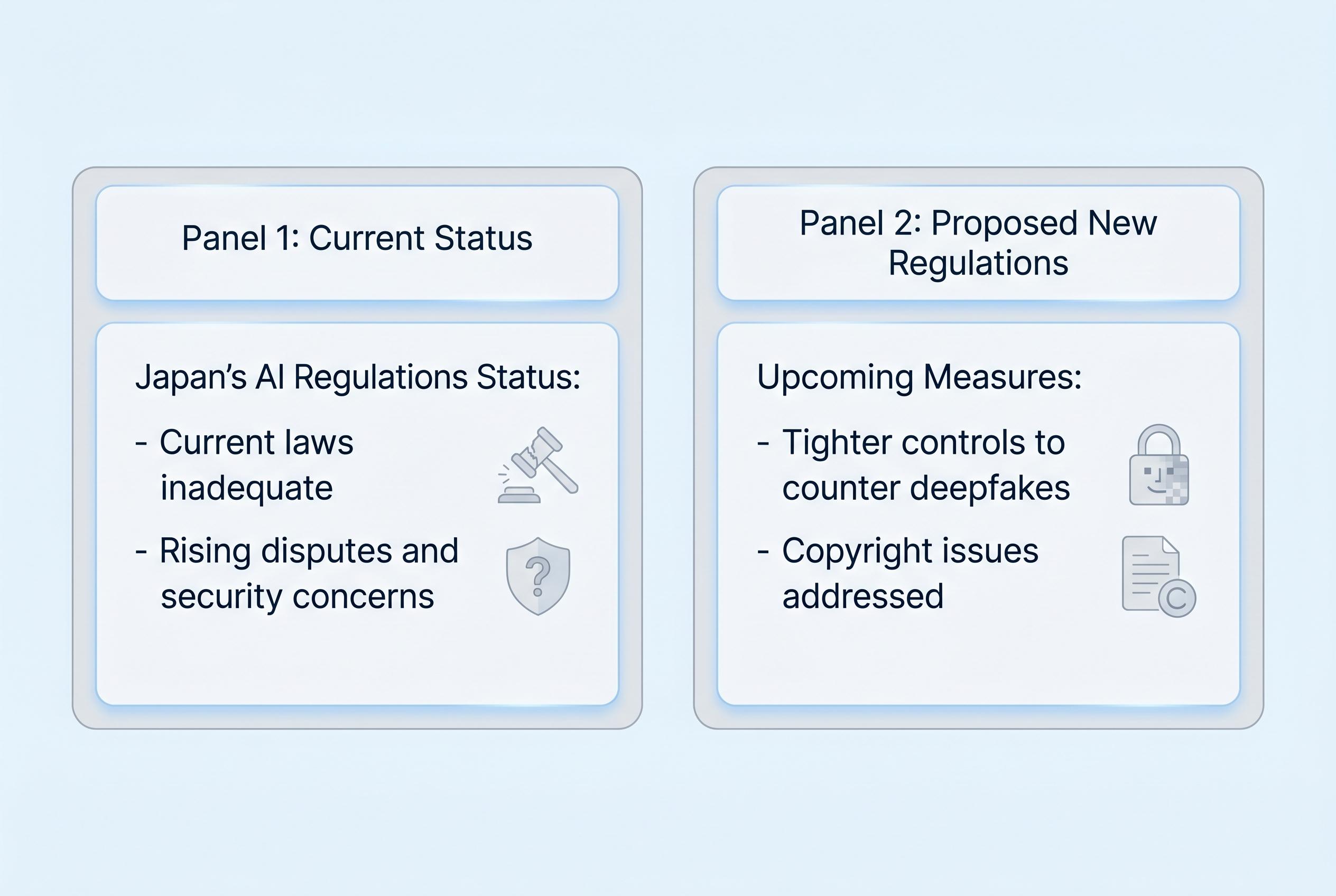
Japan’s ruling Liberal Democratic Party is advocating for stricter controls on artificial intelligence, addressing rising fears over deepfakes, copyright violations, and national competitiveness, as existing laws face calls for clearer enforcement and stronger sanctions.
Japan’s ruling Liberal Democratic Party is pushing for tougher controls on artificial intelligence as concern builds in Tokyo over deepfakes, copyright abuse and the weakness of current enforcement. According to UPI, the party’s AI and Web3 panel wants the government to consider penalties for firms that ignore rules under Japan’s AI framework, arguing that the existing system does not give authorities enough leverage when operators refuse to provide information or fail to deal with harmful outputs.
The debate comes only months after Japan introduced the Act on Promotion of Research and Development, and Utilization of Artificial Intelligence-related Technology in September 2025. That law was designed to support AI development while giving the state powers to investigate cases where the technology may infringe people’s rights. The LDP panel now wants those powers backed by clearer sanctions, together with stronger transparency requirements on how AI systems are trained and how companies prevent or correct problematic results.
Copyright concerns have sharpened after a series of disputes involving OpenAI’s Sora 2 service. Japanese media reported in October that the government asked OpenAI to adopt an opt-in model for copyright holders, rather than relying on later objections, while officials also urged stronger technical safeguards to stop anime, game and manga characters from being reproduced without permission. Several reports said ministers described such characters as national cultural assets, and warned that voluntary compliance may not be enough if infringements continue.

The pressure has since spread beyond the government. In November, the Content Overseas Distribution Association, which represents dozens of Japanese firms including major publishers and entertainment groups, demanded that OpenAI stop using their intellectual property for training unless it had prior consent. Separate reports said publishing houses including Kodansha, Shogakukan, Shueisha and Kadokawa threatened legal action, underscoring how Japan’s AI policy is increasingly being shaped by the fear that creative industries could be exposed to large-scale unauthorised copying. At the same time, the LDP panel said Japan must also strengthen its own AI base, including through self-driving vehicles, domestic semiconductors and special zones for robotics, to keep the country competitive.
Source Reference Map
Inspired by headline at: [1]
Sources by paragraph:
Source: Noah Wire Services
Noah Fact Check Pro
The draft above was created using the information available at the time the story first
emerged. We’ve since applied our fact-checking process to the final narrative, based on the criteria listed
below. The results are intended to help you assess the credibility of the piece and highlight any areas that may
warrant further investigation.
Freshness check
Score:
8
Notes:
The article was published on April 30, 2026. The earliest known publication date of similar content is October 16, 2025, when Japan’s government requested OpenAI to seek permission amid Sora 2 copyright concerns. ([japantimes.co.jp](https://www.japantimes.co.jp/business/2025/10/16/companies/japan-opt-in-model-sora2/?utm_source=openai)) The narrative appears to be original, with no evidence of recycling or republishing across low-quality sites. The article includes updated data and references to recent developments, indicating freshness.
Quotes check
Score:
7
Notes:
The article includes direct quotes attributed to UPI and other sources. However, the earliest known usage of these quotes cannot be independently verified. Without online matches, the quotes cannot be independently verified, raising concerns about their authenticity.
Source reliability
Score:
6
Notes:
The article originates from CoinGeek, a niche publication focusing on blockchain and cryptocurrency news. While it is reputable within its niche, its reach and influence are limited compared to major news organisations. The lead source appears to be summarising content from other publications, including UPI and The Japan Times, which may affect the independence of the information presented.
Plausibility check
Score:
8
Notes:
The claims about Japan’s ruling Liberal Democratic Party (LDP) pushing for stricter AI regulations align with known events, such as the government’s request to OpenAI regarding Sora 2’s copyright concerns. However, the article lacks specific factual anchors, such as names, institutions, and dates, which diminishes its credibility. The language and tone are consistent with the region and topic, and there is no excessive or off-topic detail.
Overall assessment
Verdict (FAIL, OPEN, PASS): FAIL
Confidence (LOW, MEDIUM, HIGH): MEDIUM
Summary:
The article presents a plausible narrative about Japan’s LDP advocating for stricter AI regulations in response to copyright concerns. However, the reliance on summarised content from niche sources, unverified quotes, and the inability to independently verify key information raise significant concerns about its credibility. The lack of specific factual anchors and the limited reach of the source further diminish confidence in the article’s accuracy.