


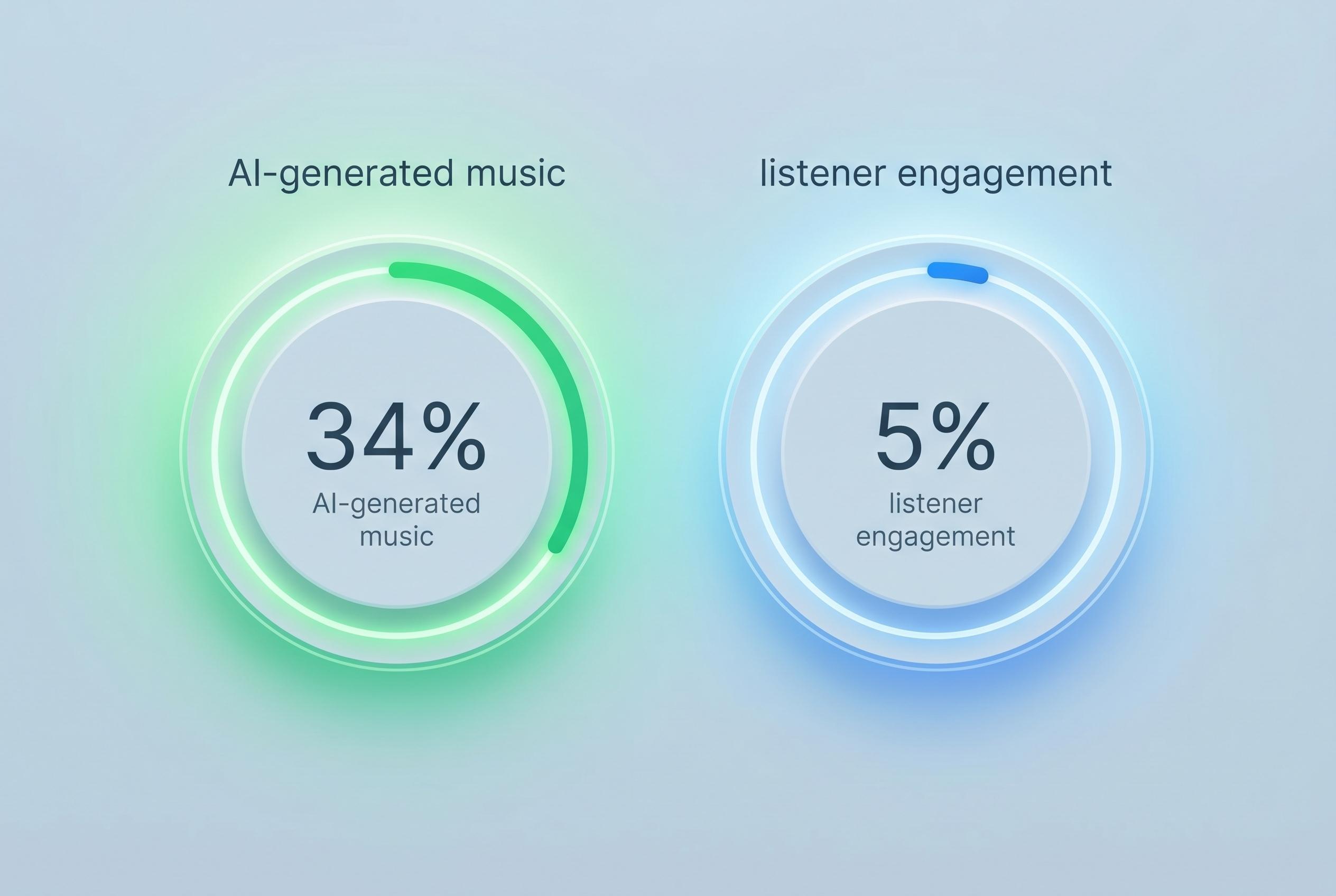
With over a third of uploads now fully AI-generated despite minimal listener impact, Apple Music and other streaming services are ramping up efforts to monitor and control synthetic tracks amid a rapid surge in AI-driven music production.
Apple Music is moving to tighten controls around synthetic songs after saying more than a third of uploads are now fully AI-generated, even though such tracks account for less than 0.5% of listening on the service, according to Oliver Schusser, Apple Music’s vice-president. Schusser said the volume of AI submissions has become impossible to ignore because labels and distributors can upload them with relative ease, and he argued the problem extends well beyond Apple’s platform.
The scale of the shift is becoming clear across the streaming sector. Deezer has said nearly half of all new music delivered to its service is now AI-generated, with roughly 75,000 synthetic tracks arriving each day. The French platform says only a small fraction of that material is actually played, but it has still responded by introducing stricter detection systems and by removing AI-tagged songs from algorithmic recommendations and editorial playlists.
Apple is now developing an internal tool linked to what it calls Transparency Tags, a feature announced earlier this year that would let labels and distributors disclose when AI was used in making a track. The system remains optional, however, which means the company is still relying on voluntary disclosure even as it seeks better visibility into the flood of machine-made uploads.

Schusser also said Apple has long treated fraud as a core moderation issue, tracing its anti-abuse efforts back to the iTunes era. According to the company, it doubled its fraud penalty this year, and since that penalty framework was introduced four years ago, fraudulent uploads have fallen by 60%. Spotify has also taken action, with the platform removing 25 million AI-generated tracks over the past year, underscoring how quickly streaming services are being forced to adapt to the rise of synthetic music.
Source Reference Map
Inspired by headline at: [1]
Sources by paragraph:
Source: Noah Wire Services
Noah Fact Check Pro
The draft above was created using the information available at the time the story first
emerged. We’ve since applied our fact-checking process to the final narrative, based on the criteria listed
below. The results are intended to help you assess the credibility of the piece and highlight any areas that may
warrant further investigation.
Freshness check
Score:
8
Notes:
The article was published on April 28, 2026, and reports on recent developments regarding AI-generated music on Apple Music. Similar reports from other sources, such as TechRadar on April 27, 2026, and Dataconomy on April 28, 2026, indicate that this information is current. ([techradar.com](https://www.techradar.com/audio/apple-music/every-label-in-the-world-is-delivering-ai-apple-music-executive-says-over-a-third-of-uploads-are-100-percent-ai-as-it-clamps-down-on-ai-fraud?utm_source=openai))
Quotes check
Score:
7
Notes:
The article includes a direct quote from Oliver Schusser, Apple Music’s vice-president, stating that “more than a third of what (Apple Music) get(s) today is actually what we would say is 100% AI.” This quote is consistent with statements made by Schusser in other recent reports. ([techradar.com](https://www.techradar.com/audio/apple-music/every-label-in-the-world-is-delivering-ai-apple-music-executive-says-over-a-third-of-uploads-are-100-percent-ai-as-it-clamps-down-on-ai-fraud?utm_source=openai)) However, the exact wording of the quote in the article cannot be independently verified, as the original source is behind a paywall. This raises concerns about the accuracy and potential misquoting of the statement.
Source reliability
Score:
6
Notes:
The article is published on Dataconomy, a niche publication focusing on data and technology topics. While it provides detailed information, the lack of a broader reputation and potential biases associated with niche publications may affect the reliability of the information presented. Additionally, the article relies on a quote from Oliver Schusser, Apple Music’s vice-president, which is consistent with statements made by Schusser in other recent reports. ([techradar.com](https://www.techradar.com/audio/apple-music/every-label-in-the-world-is-delivering-ai-apple-music-executive-says-over-a-third-of-uploads-are-100-percent-ai-as-it-clamps-down-on-ai-fraud?utm_source=openai))
Plausibility check
Score:
8
Notes:
The claim that over a third of Apple Music uploads are fully AI-generated aligns with recent reports from other sources, such as TechRadar and Dataconomy. The article also mentions that only 0.5% of users engage with this content, which is consistent with statements made by Schusser in other reports. ([techradar.com](https://www.techradar.com/audio/apple-music/every-label-in-the-world-is-delivering-ai-apple-music-executive-says-over-a-third-of-uploads-are-100-percent-ai-as-it-clamps-down-on-ai-fraud?utm_source=openai)) However, the article does not provide specific data or sources to support these claims, which raises questions about the accuracy and verifiability of the information presented.
Overall assessment
Verdict (FAIL, OPEN, PASS): FAIL
Confidence (LOW, MEDIUM, HIGH): MEDIUM
Summary:
The article reports on recent developments regarding AI-generated music on Apple Music, including a quote from Oliver Schusser, Apple Music’s vice-president. However, the original source of the quote is behind a paywall, making it difficult to verify the accuracy and context of the statement. Additionally, the article relies on a niche publication with limited reach and does not provide specific data or sources to support its claims, raising concerns about the reliability and independence of the information presented. Given these issues, the article does not meet the necessary standards for publication.